
At 89:47 in a crowded pub, a phone on the table buzzes twice. The lock screen says 2-1. The television, streaming six seconds behind, still shows 1-1. By the time the header loops in, the celebration is already over. That gap is the entire product. Mobile live score alerts are judged less by coverage than by timing, and a two-second lag can feel like a different match. I have watched people trust a notification over a broadcast they can see with their own eyes. That is a strange kind of authority, and it does not survive sloppy data. The pub test is brutal because everyone has a different clock: the TV, the betting app, the wristwatch, the friend who is still refreshing. A score is not just a number;it is a claim about the present. When the claim arrives late, the alert becomes trivia. When it arrives early and wrong, it becomes a small betrayal. The difference between those outcomes is engineering。not branding.The plumbing behind those alerts is less glamorous than the scoreline. Most apps combine a licensed feed, a websocket or server-sent event channel。and a push gateway;
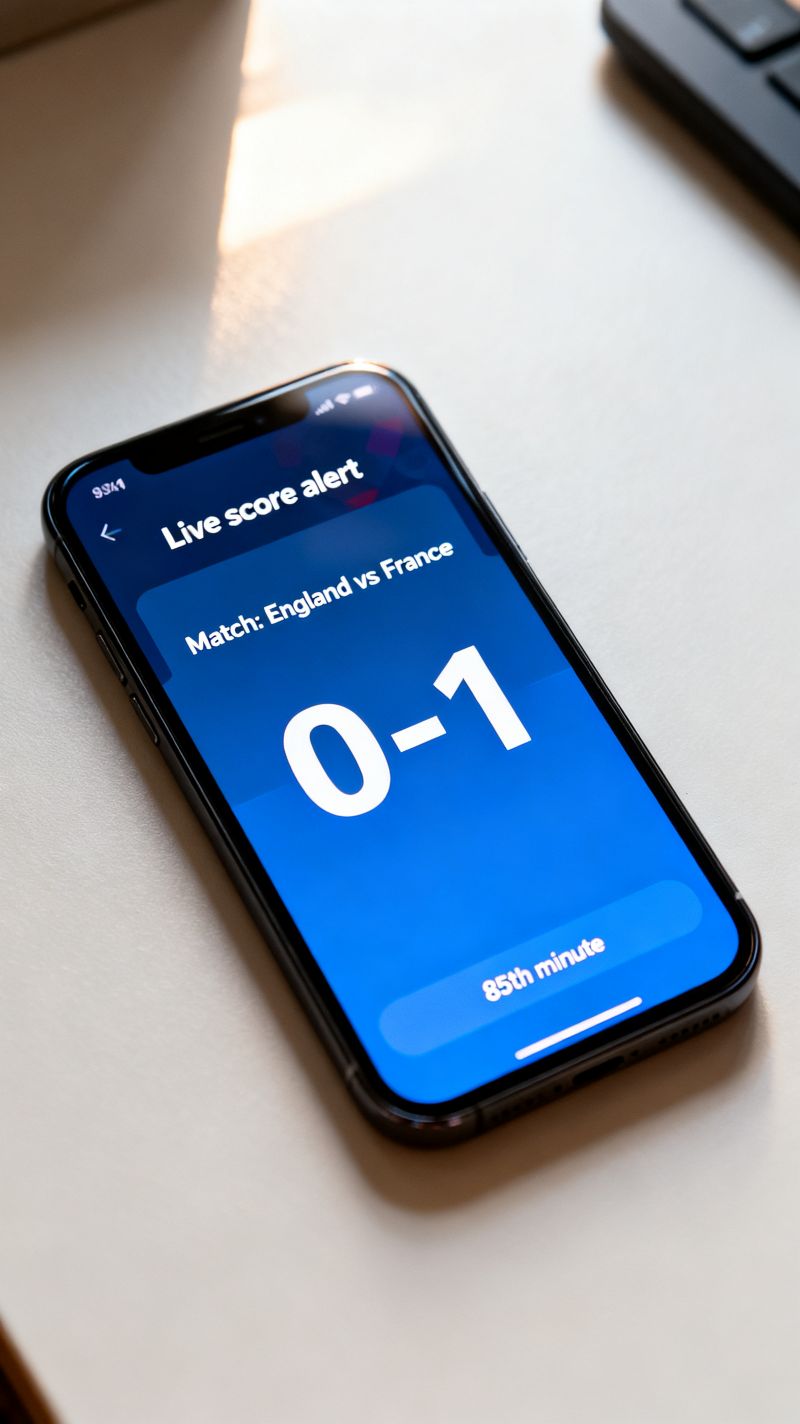
some still poll every 15 or 30 seconds because it is cheaper and easier to reason about. Polling works until it doesn't. During a Championship playoff match last season, one provider pushed a goal, then retracted it 38 seconds later after a linesman's flag. Apps that had already fired a 'GOAL' notification had to send a correction. Users did not blame the referee. They blamed the app. Mobile live score alerts need a correction policy before they need a marketing page. A simple 'goal under review' state, followed by a confirmed push, costs little and prevents a lot of mistrust. The same logic applies to VAR checks, penalties, and red cards: an alert that admits uncertainty is more useful than one that performs certainty. The latency budget is spent in three places, provider ingestion, fan-out, and the operating system's notification queue, and the last is the least visible. A payload can arrive on time and still sit behind a software update.Battery and bandwidth force harder choices. iOS and Android both restrict background work, so a naive 10-second refresh loop can flatten a phone before halftime;I have seen exactly that at a five-a-side tournament where the wifi was overloaded and the app kept retrying. Good implementations adapt: faster polling or a persistent connection during active matches, slower checks for followers of other teams, and silent pushes that wake the app only when the score changes. Stadium congestion is its own test. At a crowded ground。
a 4G cell can behave like a straw. Mobile live score alerts that assume perfect connectivity fail precisely when demand peaks. The fix is not exotic: cache the last known state, show a timestamp, and degrade to text-only updates when the pipe narrows. A missed goal is annoying;a dead battery at full time is worse. Adaptive polling is not a free lunch, but it is a better bargain than a notification that arrives after the final whistle. The best mobile live score alerts I have tested switch to a leaner cadence when the screen is off.Notification design matters as much as transport. A stack of 14 alerts for one match is not engagement;it is noise. The better pattern groups events by fixture, collapses corner notifications, and reserves interruption for goals。red cards, and final scores. On a watch, a short haptic and a three-word summary beat a paragraph. I set my own alerts to 'final 10 minutes only' for neutral matches, and I suspect most fans would benefit from the same restraint. Mobile live score alerts should answer two questions in under a second: what changed, and does it matter to me?
If the answer is buried under a generic 'match update', the alert has already failed. Personalization is not a settings maze;it is a clear contract about when the phone is allowed to interrupt. Grouping by fixture also reduces the phantom-buzz problem, where a fan hears a notification in a noisy room and checks the phone for nothing. That is why I prefer team-level toggles over a single master switch.
Trust is the last layer。and the hardest to retrofit. A score alert is a small promise: this number is current, or at least honestly timestamped. Apps that hide latency, or quietly correct a wrong score without saying so, burn that promise fast. I would rather see '2-1, 12s ago' than a clean interface that pretends to be instantaneous. For bettors, the stakes are financial;for casual fans, they are social. Both groups notice. Mobile live score alerts are infrastructure now, not a feature. The winners will be the ones that treat a two-second delay as a design problem, not a footnote. A timestamp is a form of respect. It tells the user that the app knows what it knows, and that is a surprisingly rare quality in sports notifications. That is not a technical detail;it is the product's tone.